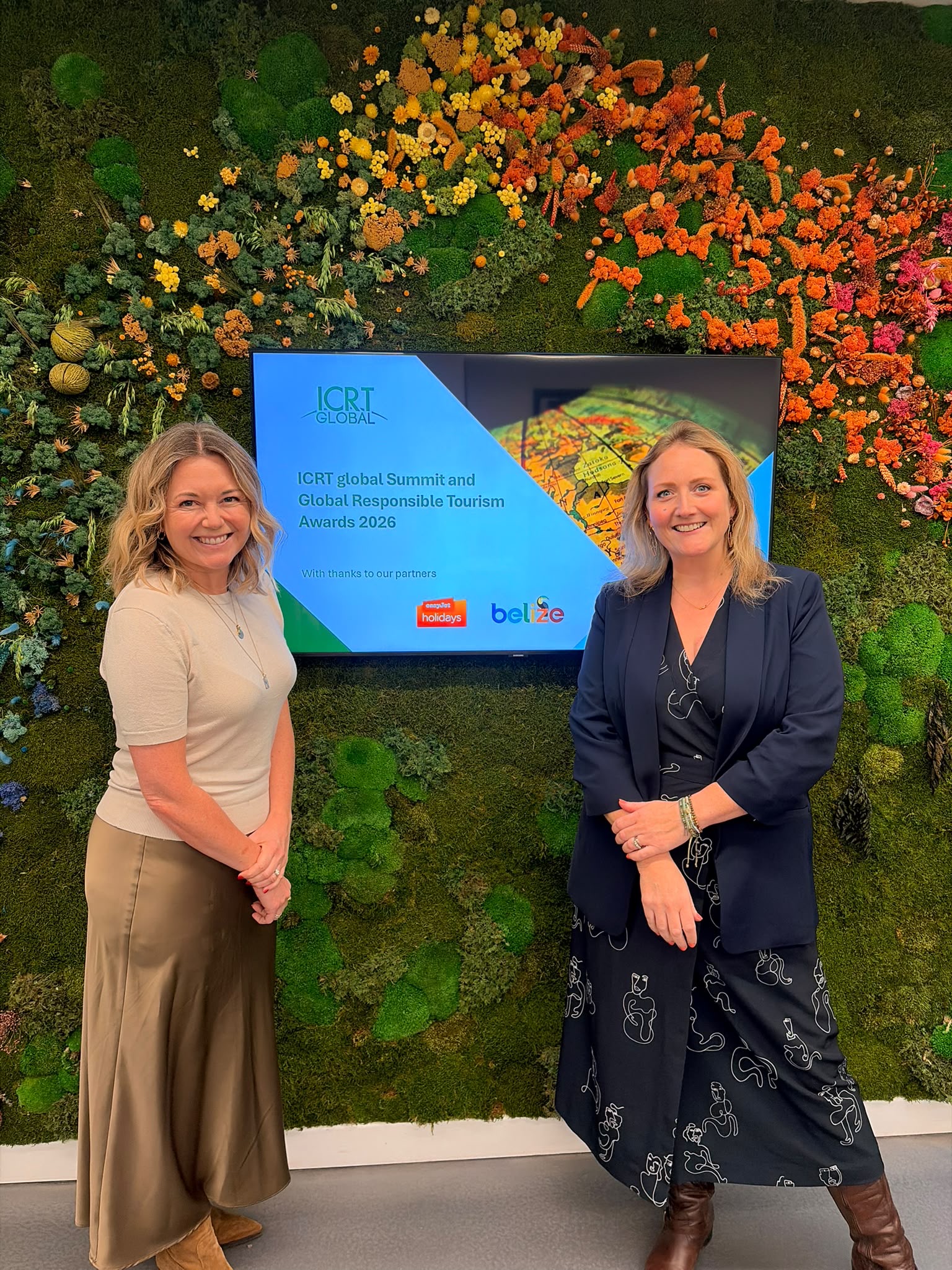
The ICRT Global Summit and Awards in London was the perfect warm-up to WTM London. An afternoon spent with people who’ve dedicated their careers to making tourism better set the tone for everything that followed. By the time the show opened the following morning, responsible tourism was firmly at the front of our minds, and it was on plenty of the stages too.
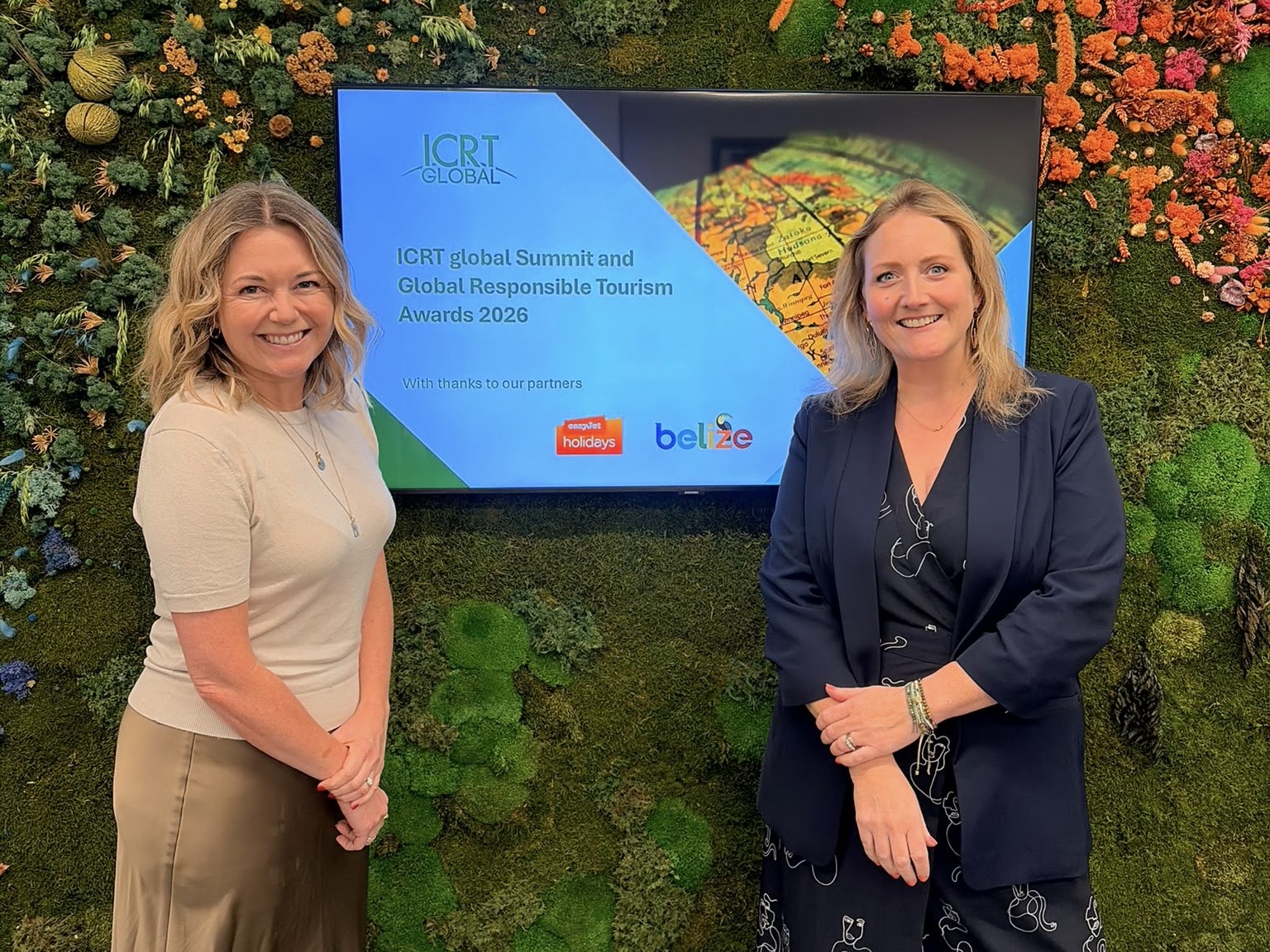
The ICRT Global Summit and Awards
The summit, supported by easyJet holidays, brought together a brilliant line-up. We heard from Matt Callaghan of easyJet holidays, Professor Harold Goodwin, founder of ICRT Global and chair of the awards judges, and the Hon. Anthony Mahler, Belize’s Minister of Tourism, among others. It was a reminder that ICRT’s work is all about moving responsible tourism from principle into practice.
Sometimes the whole mission of improving responsible tourism feels utterly overwhelming, as there is so much to do. However, I loved Matt’s suggestion that we all choose one thing in one place and make a difference, which epitomises easyJet holidays’ recent One Street Over campaign designed to spotlight lesser-known gems in well-trodden destinations.
I cut my PR teeth working for Debbie Hindle, chair of ICRT Global. Twenty years ago she had me offsetting our carbon usage before I even understood what it was, and sparked my career-long dedication to responsible tourism, so much so that I’ve been studying for my Certificate in Responsible Tourism with ICRT Global since September, and I’ve found it absolutely fascinating. Spending the afternoon with the bright minds behind the course, and the businesses putting it into practice, brought everything I’ve been swotting up on to life.
Professor Goodwin also hosted a panel to launch ICRT Global’s new working paper: Audited Accounts Can Reliably Report Social and Environmental Claims. It sets out how hotels can use the financial records they already keep to show their real contribution to the local economy, from jobs and local purchasing to tax and investment in local skills. It was tested at properties in South Africa and Eswatini and is now being trialled in Europe, with easyJet holidays encouraging its all-inclusive hotel partners to adopt it. In a world of new green-claims rules, evidence like this matters.
This year’s winners
The 2026 Global Responsible Tourism Awards went to a truly international mix of winners, including:
- Diversity, equity and inclusion: Amba Yaalu Kandalama, Sri Lanka
- Cultural diversity: CAS Trips, Czech Republic
- Local economic benefit: Céu de Montanhas, Brazil
- Nature-positive: Exodus Adventure Travels
- Regenerative tourism: RuralRevive, Namibia
- Adapting to climate change: TUI Forest Mallorca, Spain
There was also a new award for Pioneering Contribution, which recognises people who have moved responsible tourism from principle into practice. Its first recipient is Rupesh Kumar K, chief executive of the Kerala Responsible Tourism Mission Society. His Village Life Experiences in Kumarakom pay village households for visits and connect local producers with hotels. In a survey of more than 3,000 households, 70.5% of those involved in tourism rated its impact on their community as good, which is pretty impressive.
A royal seal of approval at the Wanderlust Awards
If anyone still needed convincing that responsible tourism has gone mainstream, the Wanderlust Awards settled it. Prince Harry, Duke of Sussex, was there to deliver a keynote on behalf of Travalyst, the organisation he founded. Everyone was excited, to say the least, and it was genuinely the talk of the town for the rest of the week.
For anyone less familiar with it, Travalyst is an independent, not-for-profit organisation that Prince Harry set up in 2019 to change the way the world travels for the better. It brings together some of the biggest names in travel, including Booking.com, Expedia Group, Google, Skyscanner, Tripadvisor, Trip.com Group and Visa. Together they’re working on shared ways to measure and show sustainability information, such as flight emissions, so travellers get clear, consistent information wherever they book. Harry still supports it pro bono.
When one of the most recognisable people on the planet turns up to champion this agenda in association with a magazine that promotes the road less travelled, people listen.
Responsible tourism on the WTM stages
We couldn’t get to every session, but the AI-generated notes on the WTM London 2026 Synopsis site meant we could catch up on the rest. Here’s what stood out.
Measure what stays, not who comes
“The Growth Paradox” panel, with Julie Cheetham, Travalyst’s chief executive, Alex Narracott of Much Better Adventures, Erika Harms and Juana Ortiz Basso of Los Cabos, argued that tourism’s success should be judged by how much economic and social benefit stays in local communities, not by visitor numbers. Thailand is heading the same way. Thapanee Kiatphaibool, Governor of the Tourism Authority of Thailand, and Dr Kaewta Muangasame described a shift “from volume to value,” something I know a lot of tourism boards I have worked with have been working hard to achieve, with spreading tourism regionally and seasonally becoming increasingly important.
Aviation came under the spotlight too. At the “Connected Infrastructure” session, with Ben Lynam of Travel Forward among the panel, we heard that only 9% of industry professionals rate collaboration between aviation and tourism as good. Finland was held up as the example to follow, with airlines and destinations planning routes together.
Climate risk is already changing where people go
The “Too Hot to Handle?” panel, with Kirsty Webster of Skyscanner and Helgi Eysteinsson of Iceland Travel, described demand shifting towards cooler destinations such as Scandinavia and northern Europe. As I recall from discussions at the Sky Travel Leaders’ Summit, though, this feels like a bit of a pipe dream in reality, as we Brits crave warmth in our bones come summer, and the delights of the Nordics just won’t deliver that.
Some destinations are becoming harder to insure, so flexible cancellation and rebooking are fast becoming essential. The “Redesign Now, Before the Weather Redesigns You” panel made the case for detailed local climate data, because weather hits regions and sectors very differently. Having worked on numerous weather-related crises, particularly recently in the Mediterranean and Caribbean, I believe this would help tourism boards’ desire for more shoulder-season bookings.
Communities at the centre
Harris Whitbeck of Guatemala’s tourism institute talked about going “beyond sustainability,” so that communities have real control over how their culture is shared. Mayan women weavers pushed to protect their intellectual property, and their craft now features in contemporary design rather than being borrowed from them. Guatemala’s tourism master plan was co-created with more than 2,000 people.
Pablo Menoni, Uruguay’s Minister of Tourism, explained how the country’s electricity grid now runs almost entirely on renewables, a change made in just over a decade.
Proof it can be done
Inge Huijbrechts of Radisson Hotel Group and Sean McClean presented the Radisson Blu Sheffield, a verified net-zero hotel at the heart of a £470m city-centre regeneration, complete with carbon-labelled menus. Their point was that net zero is achievable now, even in an existing building, and helps rather than hurts the bottom line.
Hide the lentils in the cake
For us, the session that hit closest to home was “Hide the Lentils in the Cake: Making Responsible Travel Desirable.” The panel included Sofya Muhrer-Muromets of Evaneos, the brilliant Debbie Hindle, chair of ICRT Global, and Tinu Mathur, and was moderated by Jamie Burr of Panoco.
Their argument was that labels like “eco,” “sustainable” and “responsible” can put travellers off rather than draw them in. Sustainability works best when it’s baked into the experience and told through great stories about people, places and culture, rather than certifications and jargon. A cake you’d want to eat, in other words, with the good stuff already inside. It is something we know firsthand from working with Intrepid, which does the most incredible work in creating positive change, but through the lens of finding “the joy in travel.” Which is crucial, as frankly a holiday is supposed to be about enjoyment, and for most of us it is just more enjoyable if you know that you haven’t harmed anyone in the process.
There’s a practical edge to this too, and the picture has shifted since the panel. The discussion pointed to the EU’s Green Claims Directive, which would have ensured that businesses get their environmental claims independently checked before using them. That has now been dropped. On 4 November, right in the middle of WTM week, the European Commission confirmed it is being withdrawn.
But before anyone starts greenwashing again, separate EU rules have applied since 27 September. Vague claims like “eco-friendly” or “green” are now banned unless they can be backed up. So are “carbon-neutral” claims that rely on offsetting, and net-zero promises without a detailed, independently monitored plan. The advance checks have gone, but the need for proof hasn’t.
If anything, that makes the “hide the lentils” approach even more sensible. If you can’t lean on a label, you have to show what you’re actually doing and tell that story well. That’s exactly where ICRT’s new working paper and good communications meet, and it’s a conversation we’d love to have with more of the brands we work with.
Want to dig deeper?
If any of this has sparked your interest, ICRT Global has shared some excellent follow-up reading:
- The 2026 Global Responsible Tourism Awards and the shortlist citations
- The new Pioneering Contribution award
- How to enter the 2027 awards. Entry is free, and you enter through one of six regional awards, with the global winners announced on 1 November 2027.
- ICRT Global's new working paper on reporting local economic impact
- easyJet holidays' sustainability work
- Belize Tourism Board on sustainability
- ICRT Global's 2027 brochure
- Sign up to ICRT Global's newsletter or follow them on LinkedIn
If you’re doing great things in responsible tourism and want help telling that story, without the jargon and with the evidence to back it up, we’d love to hear from you.